
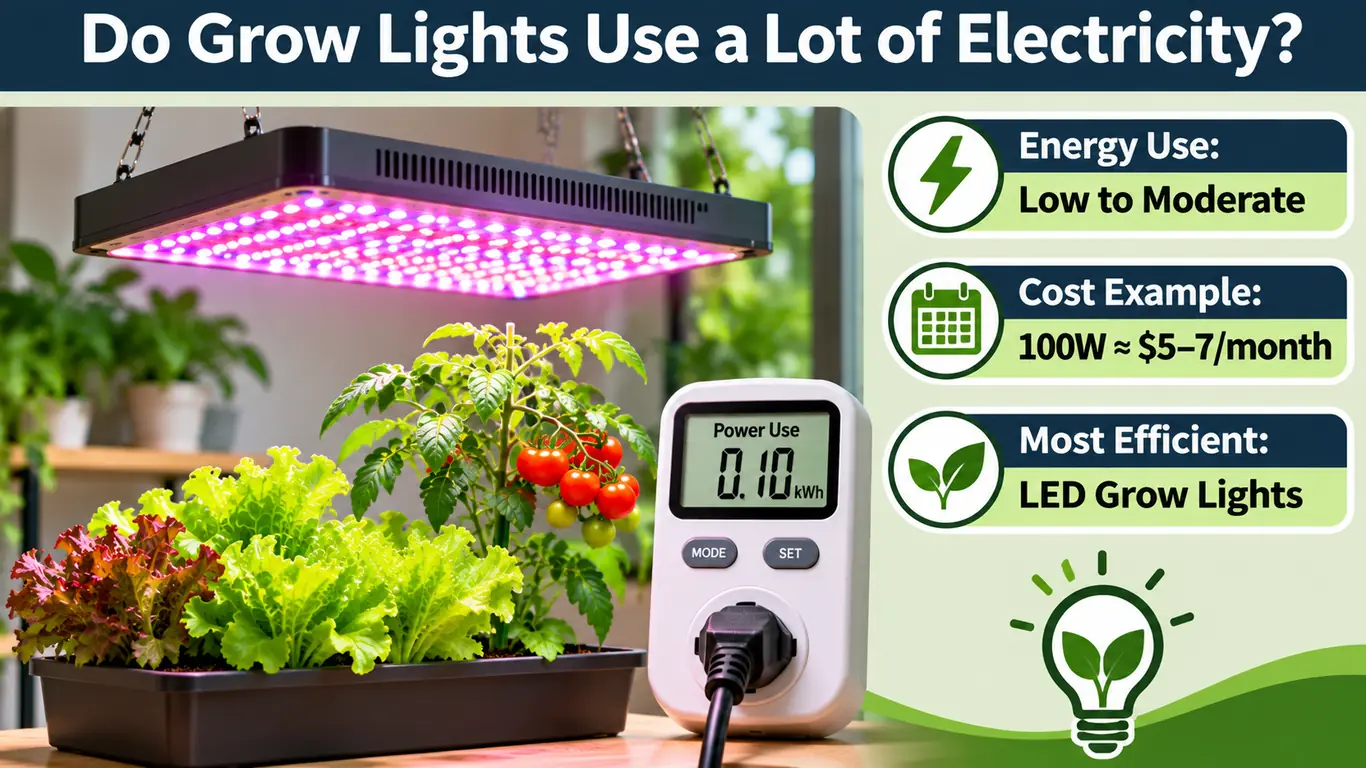
Grow lights are essential for indoor gardening, but many plant owners worry about their impact on electricity bills. Whether you are growing herbs, vegetables, seedlings, or houseplants, understanding how much energy grow lights consume can help you manage costs. Fortunately, modern LED grow lights are generally energy-efficient and do not always require large amounts of electricity. However, their operating costs depend on wattage, daily usage, and local electricity rates. This guide explains how much electricity grow lights use, their monthly costs, and practical ways to save energy.
Do Grow Lights Use a Lot of Electricity?
No, most small LED grow lights do not use a lot of electricity. However, powerful grow lights used for large indoor gardens can noticeably increase monthly energy bills.
A typical 20–100W LED grow light uses relatively little electricity compared with a high-powered 400–600W growing system. The actual amount depends on how many hours the lights operate each day.
For example, a 100W LED grow light running 14 hours daily consumes approximately 42 kilowatt-hours (kWh) per month. At an illustrative electricity rate of $0.15 per kWh, that costs about $6.30 monthly.
How Much Electricity Do Grow Lights Use?
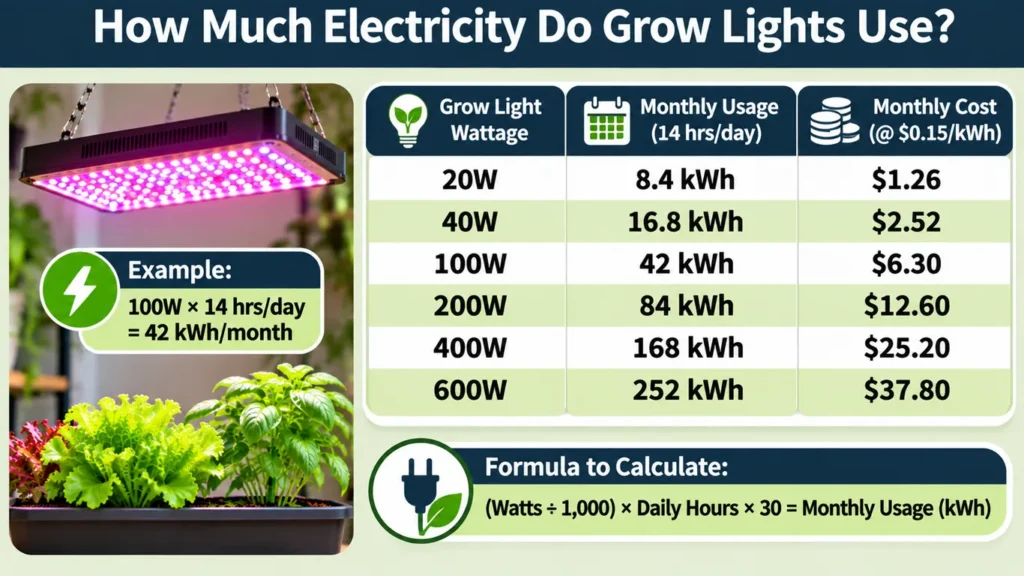
Grow lights consume electricity based on their actual wattage and operating time. Smaller bulbs designed for houseplants generally use less power than large LED panels designed for fruiting vegetables.
Understanding electricity consumption helps you choose suitable lighting equipment without spending unnecessarily on power.
Grow Light Electricity Consumption by Wattage
The following table estimates monthly electricity consumption when grow lights operate for 14 hours daily over 30 days.
| Grow Light Wattage | Monthly Usage | Monthly Cost |
| 20W | 8.4 kWh | $1.26 |
| 40W | 16.8 kWh | $2.52 |
| 100W | 42 kWh | $6.30 |
| 200W | 84 kWh | $12.60 |
| 400W | 168 kWh | $25.20 |
| 600W | 252 kWh | $37.80 |
Costs assume $0.15 per kWh. Actual rates vary by location and electricity provider. These estimates cover the lights only.
Does Higher Wattage Mean More Electricity?
Yes. Higher-wattage lights consume more power when operated at full rated input.
For example, a 200W fixture uses twice as much electricity as a 100W fixture operating for the same period.
However, a higher-wattage light may illuminate a larger growing area. Comparing plant-light output and coverage is therefore more useful than choosing based on wattage alone.
How Much Does It Cost to Run Grow Lights?
The cost of operating grow lights depends on electricity prices, wattage, and daily lighting hours. You can estimate your monthly expenses using a simple calculation.
How to Calculate Grow Light Electricity Costs
Use the following formula:
Monthly electricity usage (kWh) = (Watts ÷ 1,000) × Daily hours × 30
Multiply the result by your electricity rate to calculate the monthly cost.
For example, consider a 150W grow light operating 16 hours daily:
- Convert watts to kilowatts: 150 ÷ 1,000 = 0.15 kW.
- Calculate daily usage: 0.15 × 16 = 2.4 kWh.
- Calculate monthly usage: 2.4 × 30 = 72 kWh.
- Calculate monthly cost: 72 × $0.15 = $10.80.
Therefore, this grow light costs approximately $10.80 per month under the assumed electricity rate.
Do Grow Lights Increase Your Electricity Bill?
Grow lights increase electricity consumption whenever they operate, but the impact may be relatively small for a few low-wattage LED bulbs.
A large growing setup can cost considerably more, especially when ventilation fans, heaters, or air conditioning are required.
The total electricity bill depends on the entire system rather than lighting alone.
Do LED Grow Lights Use a Lot of Electricity?
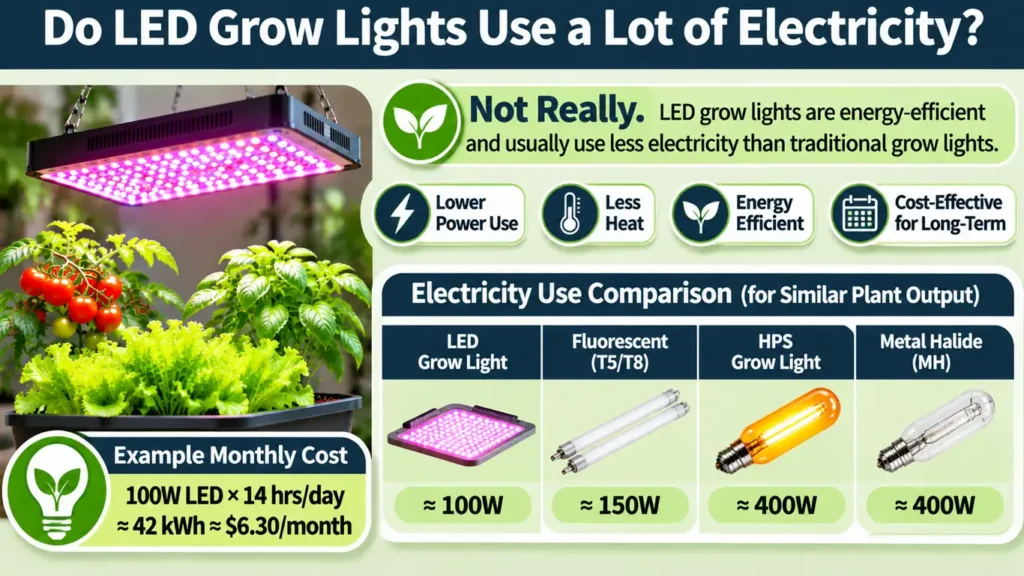
LED grow lights are generally among the most energy-efficient options for indoor gardening. They convert electrical energy into plant-usable light more efficiently than many traditional lighting technologies.
This makes them suitable for gardeners who need consistent lighting without unnecessarily high operating costs.
LED vs. Traditional Grow Lights
| Grow Light Type | Energy Efficiency | Heat Output |
| LED grow lights | High | Generally lower |
| Fluorescent grow lights | Moderate | Relatively low |
| HPS grow lights | Lower than modern efficient LEDs | High |
| Metal halide grow lights | Lower than modern efficient LEDs | High |
| Incandescent grow bulbs | Very low | High |
Modern LEDs can provide similar plant-light output while consuming less electricity than many traditional fixtures.
Are LED Grow Lights Cheaper to Run?
LED grow lights often cost less to operate because of their efficiency and relatively long service life.
They also produce less unwanted heat, which may reduce cooling requirements in enclosed growing spaces.
However, not every LED fixture is equally efficient. Compare actual power consumption, coverage, and photosynthetic photon efficacy (PPE) before purchasing.
What Factors Affect Grow Light Electricity Consumption?
Several factors influence how much electricity indoor grow lights use. Understanding these variables can help you estimate operating costs more accurately.
The most important factors include the following:
- Actual wattage: A 200W grow light consumes more electricity than a 50W light when both operate at full power.
- Daily operating hours: Running lights for 16 hours consumes more energy than running them for 12 hours.
- Number of fixtures: Multiple grow lights increase total electricity consumption.
- Lighting technology: Modern efficient LEDs generally use less electricity for equivalent plant-light output.
- Dimming settings: Some dimmable fixtures consume less power when operated at reduced brightness.
- Plant requirements: Fruiting vegetables usually require more light than low-light houseplants.
- Additional equipment: Fans, heaters, humidifiers, and cooling systems add to total growing expenses.
Choosing the appropriate lighting setup for your plants can reduce unnecessary energy consumption.
Which Grow Lights Use the Least Electricity?
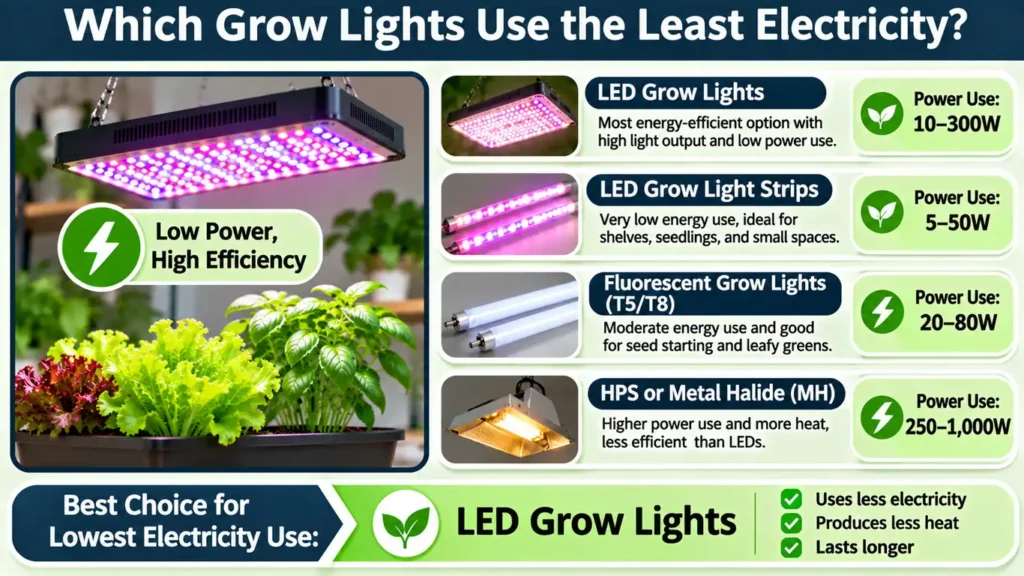
Different types of grow lights have different energy requirements. Selecting an appropriate fixture depends on plant size, growing area, and desired light intensity.
Low-Wattage LED Grow Bulbs
Small LED grow bulbs often consume approximately 10–30W. They are useful for individual houseplants, small herbs, and supplemental lighting.
These bulbs can provide economical lighting when their output is sufficient for the plants.
LED Grow Light Strips
LED strips commonly operate at relatively low wattages and work well for shelves, seed-starting stations, and compact indoor gardens.
Their electricity consumption depends on strip length, brightness, and total power draw.
Full-Spectrum LED Grow Panels
Full-spectrum LED panels are available in many wattages. Smaller panels are suitable for leafy vegetables, while larger fixtures can support extensive growing areas.
Although powerful panels consume more total electricity, an efficient fixture can provide better growing-area coverage.
How to Reduce Grow Light Electricity Costs
You can lower grow light electricity expenses without compromising plant health by improving lighting efficiency and avoiding unnecessary operating hours.
Small changes in lighting schedules and equipment selection may create noticeable savings over time.
Practical Energy-Saving Tips
- Choose efficient LED grow lights. Select fixtures with good plant-light efficiency rather than relying on advertised wattage.
- Use an automatic timer. Timers prevent lights from operating longer than necessary.
- Match lighting hours to plant needs. Many indoor seedlings and vegetables benefit from approximately 12–16 hours of artificial lighting, depending on species and intensity.
- Adjust the light distance. Proper positioning helps plants receive adequate light without wasting energy illuminating surrounding areas.
- Take advantage of natural sunlight. Supplemental sunlight may reduce the amount of artificial lighting required.
- Use dimmable fixtures. Reduce brightness when plants require less intense lighting.
- Group plants with similar lighting needs. Proper grouping can help one fixture illuminate several compatible plants efficiently.
Should Grow Lights Stay On 24 Hours?
Most indoor plants do not need continuous artificial lighting. Many species benefit from a regular period of darkness.
Operating lights continuously also increases electricity consumption.
For example, a 100W light running 24 hours daily consumes 72 kWh over 30 days, compared with 48 kWh when operated for 16 hours daily.
Using a suitable lighting schedule can reduce costs while supporting healthy growth.
FAQs
1. Do Grow Light Bulbs Use a Lot of Electricity?
Most small LED grow light bulbs consume relatively little electricity. A 20W bulb running 14 hours daily uses approximately 8.4 kWh monthly. Its operating cost depends on local electricity rates, making it an economical option for small indoor plants.
2. How Much Electricity Does a 100W LED Grow Light Use?
A 100W LED grow light running 12 hours daily consumes approximately 36 kWh monthly. At $0.15 per kWh, the estimated monthly cost is $5.40. Running it longer increases electricity consumption proportionally.
3. Are Grow Lights Expensive to Run All Day?
Running grow lights continuously can become expensive, particularly with high-powered fixtures. A 200W light operating 24 hours daily consumes approximately 144 kWh monthly. Most plants do not require continuous lighting, so an appropriate timer can reduce unnecessary expenses.
4. Do Indoor Grow Lights Use More Electricity Than Regular Lights?
Indoor grow lights can consume more electricity than ordinary household bulbs, particularly when they operate for extended periods. However, small LED grow bulbs may use similar power to regular LED bulbs. Total usage depends primarily on wattage and operating hours.
5. What Is the Most Energy-Efficient Grow Light?
A high-quality LED grow light with strong photosynthetic photon efficacy is generally one of the most energy-efficient choices. The best fixture provides sufficient plant-usable light while minimizing wasted electricity and excessive heat. Compare efficiency ratings, coverage, and actual power draw before buying.