
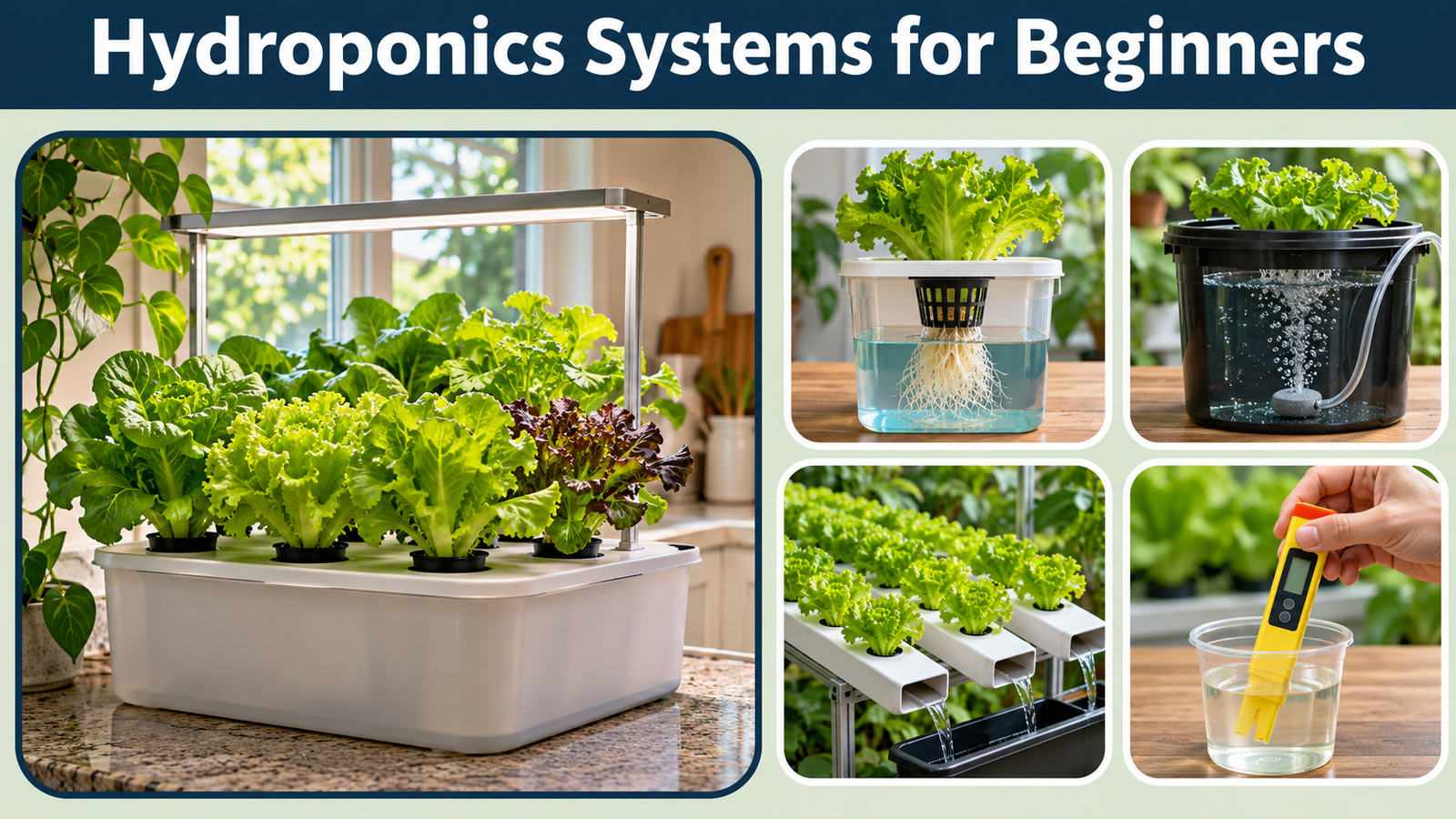
Hydroponics lets you grow vegetables and herbs in water enriched with plant nutrients. You can start with a single lettuce plant in a container on a sunny balcony or grow several plants indoors under a light. The right setup depends on what you want to grow, how much space you have, and how often you can check on your plants.
The easiest hydroponic systems for beginners are the Kratky method and deep water culture (DWC). Kratky uses a container and a nutrient solution, while DWC adds an air pump to keep the water oxygenated. This guide compares both with four other systems and walks you through setting up your first lettuce plant.
What Is a Hydroponic System?
A hydroponic system delivers water and dissolved nutrients directly to plant roots. The roots may hang in a reservoir, sit in a growing medium such as coco coir, or grow along a channel with water flowing past them. Every setup needs a way to give the roots access to oxygen. Plants also need adequate light and enough room to develop.
What Do You Need to Grow Plants Hydroponically?
A basic setup includes an opaque reservoir, a way to support the plant, a complete hydroponic fertilizer, and a light source. A small mesh container called a net pot can hold a seedling plug while allowing roots to grow through the openings. Depending on the system, you may also need an air pump, a water pump, or a timer.
A pH test kit or meter helps you check whether the solution is in a suitable range for your crop. Many common leafy greens grow well around pH 5.5 to 6.5. An electrical conductivity (EC) meter is useful as you expand because it measures dissolved salts and helps you track changes in nutrient concentration.
6 Types of Hydroponic Systems for Beginners
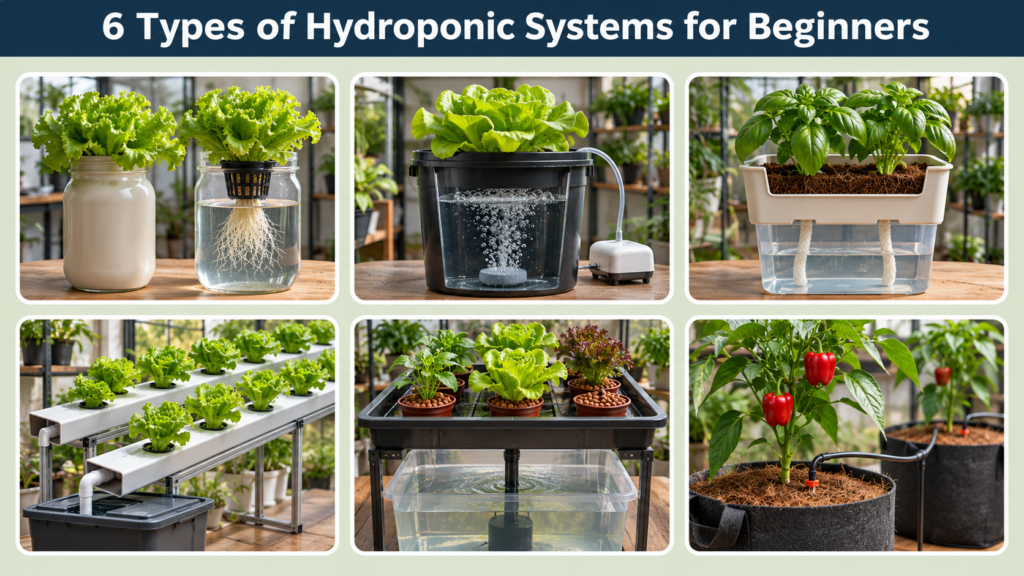
Hydroponic systems differ mainly in how they bring nutrient solution and oxygen to the roots. Passive systems use resting water or absorbent material. Active systems use pumps to aerate the reservoir or move water through the growing area.
| System | How it works | Good first crops | Equipment and upkeep |
|---|---|---|---|
| Kratky | The falling water level creates an air gap for upper roots | Lettuce, pak choi | No pump. Start with a reservoir sized for the crop. |
| Deep water culture | An air pump and air stone oxygenate the nutrient solution | Lettuce, basil | Requires continuous aeration and regular water checks. |
| Wick | An absorbent wick carries solution into a growing medium | Small herbs, leaf lettuce | No pump. Wick capacity limits how much water reaches the roots. |
| Nutrient film technique | A shallow stream of solution flows through sloped channels | Lettuce, compact greens | Requires a water pump and correctly sloped channels. |
| Ebb and flow | A grow tray floods periodically and drains into a reservoir | Basil, leafy greens | Requires a pump and a timer. |
| Drip | Tubing delivers nutrient solution to each plant’s growing medium | Compact peppers, cucumbers | Requires tubing and emitters that need periodic checks. |
1. Kratky Method
In a Kratky system, a plant sits above a reservoir with its roots reaching into the nutrient solution. As the plant uses water, the level falls and exposes part of the root system to air. Lower roots continue to absorb water and nutrients.
Kratky is a practical first choice if you want to grow one or two heads of lettuce without buying a pump. Choose a container large enough for the crop. If you need to top it up later, keep the established air gap so the upper roots remain exposed.
2. Deep Water Culture
In deep water culture, a net pot holds the plant above a reservoir while its roots extend into the solution. An air pump pushes air through an air stone, producing bubbles that help oxygenate the water. A single opaque bucket is enough for a simple DWC setup.
DWC suits beginners who want to grow lettuce or basil and have a reliable power supply. The pump typically runs continuously. Check the water level as the plant grows, since a mature plant can use noticeably more water than a seedling.
3. Wick System
A wick system draws nutrient solution from a reservoir into a growing medium. One end of the wick sits in the solution, and the other reaches into the container holding the plant. It works on the same principle as a self-watering planter.
Wick systems are simple to build and work best with small plants that use water slowly. The growing medium needs to hold moisture while allowing air around the roots. If the medium stays soggy or dries too quickly, check the wick material, the number of wicks, and how much of each wick touches the medium.
4. Nutrient Film Technique
Nutrient film technique, or NFT, uses a pump to send a shallow stream of nutrient solution through slightly sloped channels. Part of the root system contacts the flowing solution while the rest has access to air. The solution drains back into the reservoir and recirculates.
NFT makes efficient use of space when you want several rows of lettuce. It takes more setup than a single bucket because each channel needs suitable flow and drainage. Check for pooling and roots blocking the return path. A pump interruption can dry out exposed roots quickly.
5. Ebb and Flow
An ebb-and-flow system pumps nutrient solution into a grow tray at timed intervals. After each flood cycle, the solution drains back into the reservoir, allowing air to reach the roots. Individual pots in the tray can hold a medium such as expanded clay pebbles.
This design is useful if you want to grow several plants in separate pots on one tray. Flood timing depends on the medium, the size of the plants, and how quickly the setup dries. Check moisture around the roots before adjusting the timer.
6. Drip System
A drip system uses tubing and small emitters to deliver nutrient solution near the base of each plant. The solution spreads through a growing medium such as coco coir. In some setups, excess solution returns to the reservoir for reuse.
Drip irrigation works well for larger plants that need support, such as peppers and cucumbers. It also adds a maintenance step. An emitter can clog while the rest of the system continues to run, so check that each plant receives water.
How to Start a Simple Kratky Lettuce System
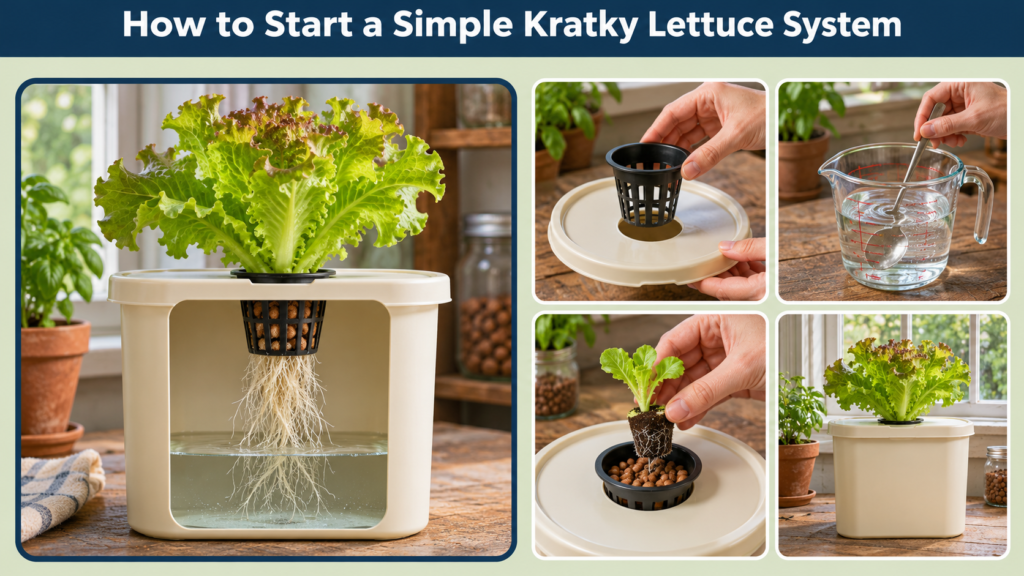
A single lettuce plant gives you a manageable first project. Use an opaque, food-safe container with a lid, a net pot, a seedling plug, and a complete hydroponic fertilizer. Start seeds separately so you can move a seedling into the reservoir once its roots begin to emerge from the plug.
- Prepare the lid. Make an opening that holds the net pot securely. Cover any unused holes to keep light out of the reservoir and limit algae growth.
- Mix the nutrient solution. Follow the fertilizer’s instructions for young plants or leafy greens. If the product uses multiple concentrates, add them separately to the water as directed.
- Check the pH. Test the solution after mixing. Aim for the recommended range for lettuce and retest after making any adjustment.
- Set the starting water level. Position the seedling so its emerging roots can reach the solution, or start with the solution just touching the bottom of the net pot to keep the plug moist. Keep the stem and leaves above water.
- Provide light. Place the container in a bright growing area or beneath a grow light. Follow the fixture’s guidance on hanging distance and check how the plant responds.
- Monitor growth. As the roots grow and the water level drops, leave room for the air gap to form. Check the reservoir regularly, especially as the lettuce gets larger.
Best Plants for a First Hydroponic Garden
Leaf lettuce is a good first crop because it fits in small systems and you can harvest its outer leaves as it grows. Pak choi is another option for growers interested in compact greens. Basil grows well in hydroponics and can provide repeated harvests when you trim it above a pair of leaves.
Fruiting plants such as tomatoes, peppers, and cucumbers need stronger light, more root space, and often a trellis or stake. They also use more water as they mature. If you want to start with a fruiting crop, choose a compact variety and a system that supports its mature size.
Common Hydroponic Problems and How to Fix Them

When growth slows or leaves change color, check the light, water level, pH, and root condition before increasing the fertilizer dose. These problems can look similar above the waterline, so it helps to check one condition at a time.
| Problem | What to check first |
|---|---|
| Green film inside the reservoir | Check for light entering through a translucent container, the lid, or gaps around the net pot. |
| Tall, thin seedlings | Check whether the seedlings are receiving enough light and whether the fixture is too far away. |
| Slimy roots with an unpleasant smell | Check water temperature and oxygen supply. In DWC, confirm the pump and air stone are working. |
| Older leaves turning yellow | Check pH and review how the nutrient solution was mixed. |
| Seedling wilting shortly after transplanting | Check whether the young roots can reach the solution and whether the plug has dried out. |
Frequently Asked Questions
What is the easiest hydroponic system for beginners?
Kratky is usually the easiest starting point because it requires no pump or plumbing. One opaque container and a lettuce seedling are enough to try the method.
Can I use tap water for hydroponics?
Many growers use tap water. Test the pH after mixing in nutrients. If the pH rises repeatedly, the water’s alkalinity may be contributing to the problem.
Does hydroponics need electricity?
Kratky and wick systems can run without electricity when plants receive enough natural light. Deep water culture, NFT, and most other active systems need electricity for their pumps.
How often should I change the nutrient solution?
It depends on the reservoir size, crop, and system. In a recirculating setup, follow the fertilizer manufacturer’s guidance and check water level, pH, and nutrient concentration between changes.
Can I use regular garden fertilizer in a hydroponic system?
Choose a complete fertilizer formulated for hydroponics. Some garden fertilizers rely on soil to supply part of the nutrition, while hydroponic plants depend on the solution for their mineral nutrients.