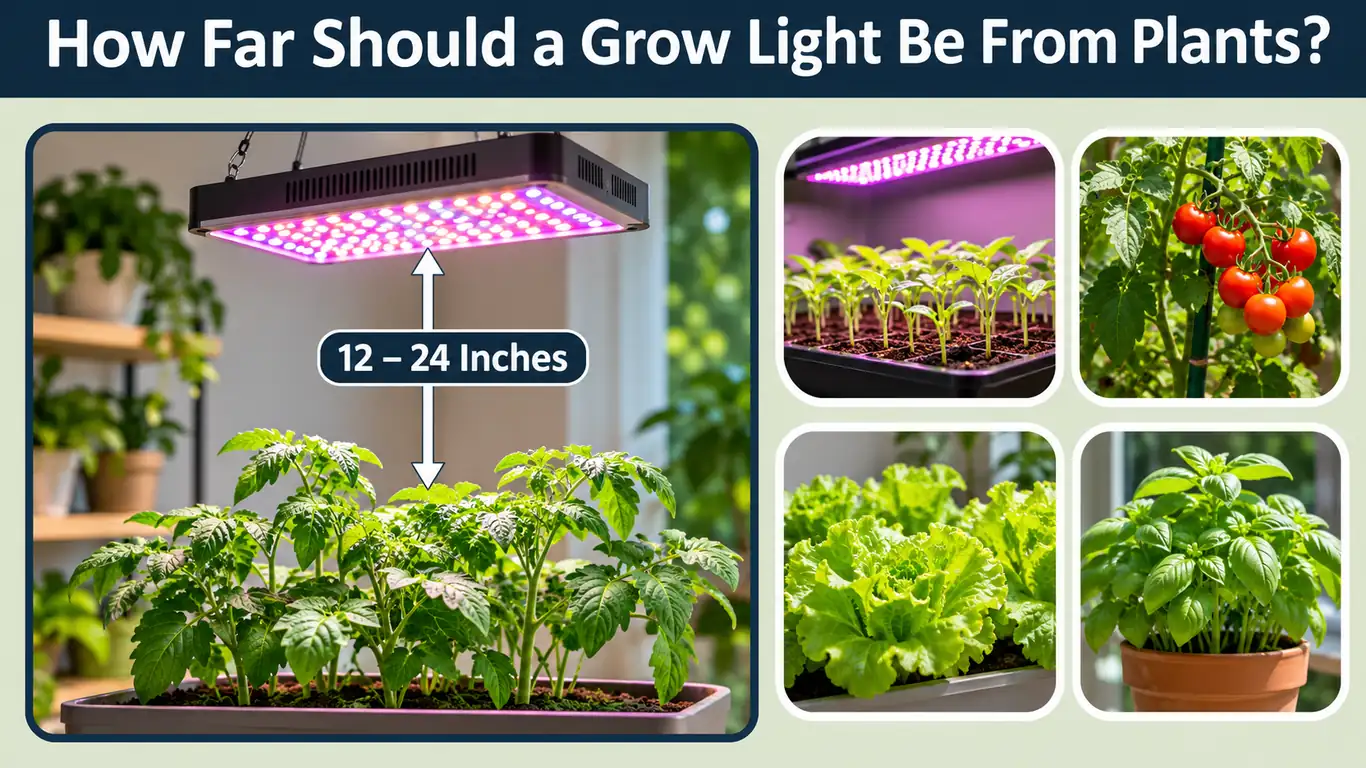
Grow lights help indoor plants grow stronger, healthier, and faster by providing the artificial light they need for photosynthesis. However, placing them too close can cause leaf damage, while keeping them too far away may result in weak growth and stretching stems. Understanding how far a grow light should be from plants is essential for successful indoor gardening. The ideal distance depends on the light type, wattage, plant species, and growth stage. Proper positioning helps your plants receive enough light without unnecessary stress.
How Far Should a Grow Light Be From Plants?
Most indoor plants grow well when LED grow lights are positioned approximately 12–24 inches above their leaves. However, smaller LED fixtures may need to be closer, while powerful lights require greater clearance. Fluorescent lights generally work best at shorter distances because they produce less intense light.
The following table provides general starting distances for common grow light types.
| Grow Light Type | Recommended Distance |
| Low-power LED grow lights | 8–12 inches |
| Standard LED grow lights | 12–24 inches |
| High-power LED grow lights | 18–36 inches |
| Fluorescent T5/T8 seedling lights | 2–6 inches |
| HPS grow lights | 18–36 inches |
| Metal halide grow lights | 18–36 inches |
These measurements are starting points rather than universal requirements. Always follow your fixture manufacturer’s recommendations and measure the distance from the light to the top of the plant canopy.
How Far Should LED Grow Lights Be From Plants?
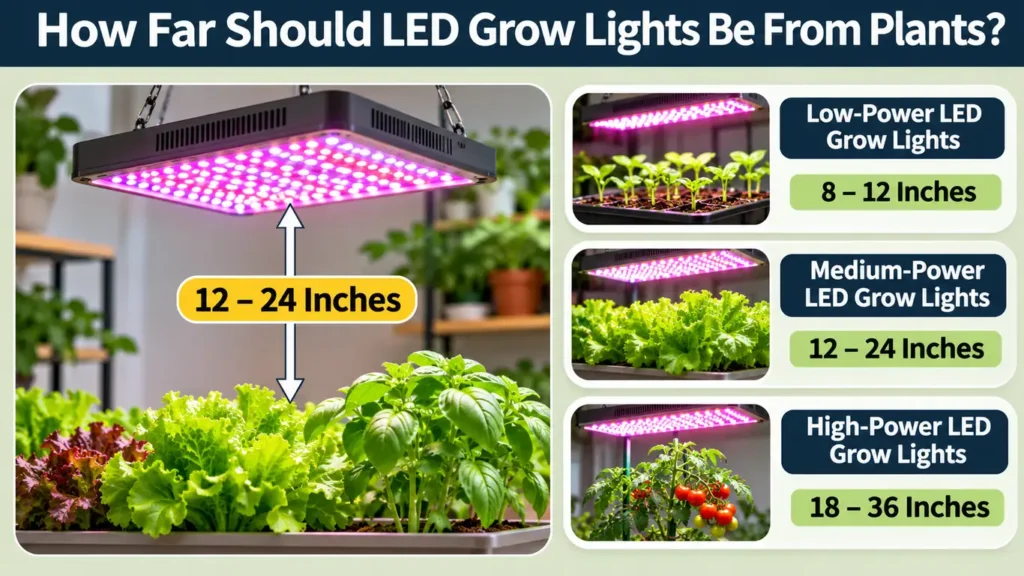
LED grow lights are popular for indoor gardening because they are energy-efficient, long-lasting, and available in different intensities. However, the appropriate distance depends on their actual power output, light distribution, and the plants being grown.
Low-Power LED Grow Lights
Small LED strips and seed-starting fixtures can often be positioned around 8–12 inches above plants.
These lights work well for seedlings, herbs, and small indoor plants. Because their intensity is relatively low, placing them closer helps plants receive adequate light for healthy development.
Some low-output LED fixtures are designed to operate even closer, so checking their specifications is important.
Medium-Power LED Grow Lights
Many standard LED grow lights work well at approximately 12–24 inches above the plant canopy.
They are suitable for growing leafy vegetables, indoor herbs, and mature houseplants.
Start at the manufacturer’s suggested height and adjust according to plant response. Moving the light closer increases intensity, while raising it spreads the light across a larger growing area.
High-Power LED Grow Lights
Powerful LED fixtures often require 18–36 inches or more of clearance, depending on their design and dimming settings.
These lights are commonly used for large indoor growing spaces, tomatoes, peppers, and other high-light crops.
Even though LEDs produce less radiant heat than traditional HID lights, intense light can still damage leaves when the fixture is positioned too close.
How Far Should Grow Lights Be From Plants at Different Stages?
Plants have different lighting requirements throughout their development. Young seedlings generally need gentler light than mature flowering or fruiting plants.
Adjusting grow light distance during each stage helps prevent weak stems, excessive stretching, and light stress. The correct position also depends on whether the light can be dimmed.
1. Seedling Stage
Seedlings require enough light to develop compact stems and healthy early leaves.
Recommended starting distances include:
- Low-power LED lights: 8–12 inches.
- Fluorescent seedling lights: 2–6 inches.
- High-output LEDs: Follow manufacturer guidance, usually with greater clearance or reduced brightness.
Provide approximately 14–16 hours of light daily for most vegetable seedlings.
2. Vegetative Growth Stage
During vegetative growth, plants develop stems, branches, and leaves.
Many medium-power LED fixtures can be positioned approximately 12–24 inches above the canopy.
Consistent light encourages compact growth and strong foliage. Raise the fixture as plants become taller to maintain a suitable distance.
3. Flowering and Fruiting Stage
Flowering and fruiting plants often require more intense light than young seedlings.
Depending on the fixture, growers may increase brightness or adjust the light closer to the canopy.
However, reducing distance too aggressively can cause bleaching, curling, and damaged foliage. Use a light-intensity measurement rather than distance alone whenever possible.
How Far Should Grow Lights Be From Different Plants?
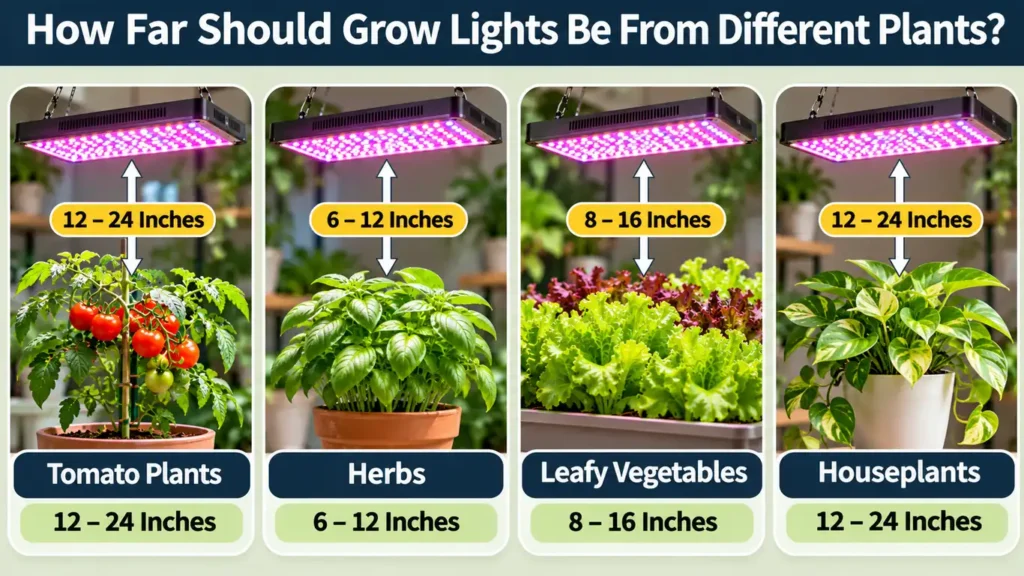
Different plant species require different light intensities. Leafy greens and shade-tolerant houseplants generally need less light than tomatoes or other fruiting vegetables.
Although growing requirements vary between varieties, the following distances provide useful starting points for common indoor plants.
Tomato Plants
Indoor tomato plants require relatively strong lighting, especially during flowering and fruit production.
With many medium-to-high-power LED fixtures, a starting distance of approximately 12–24 inches may be appropriate, depending on brightness.
Tomatoes also need adequate daily light exposure to support vigorous growth and fruit development. Monitor their upper leaves and adjust the fixture gradually.
Herbs and Leafy Vegetables
Basil, lettuce, spinach, parsley, and similar leafy plants typically grow well under moderate LED lighting.
A distance of approximately 6–12 inches can work for suitable low-output fixtures. More powerful panels should be mounted higher or dimmed.
Positioning the light correctly encourages compact foliage and reduces excessive stem stretching.
Indoor Houseplants
Many foliage houseplants prefer moderate rather than intense light.
A standard LED grow light positioned around 12–24 inches above the canopy can provide useful supplemental lighting.
Pothos, philodendrons, and similar plants often need less intensity than succulents and other sun-loving species.
Observe the leaves regularly because their appearance can indicate whether adjustments are necessary.
Signs Your Grow Light Is Too Close to Plants
A grow light positioned too close can expose plants to excessive brightness or heat. The symptoms may develop gradually, especially when using powerful LED fixtures.
Recognizing early warning signs helps prevent permanent leaf damage and allows plants to recover before growth is seriously affected.
Common Signs of Excessive Light
- Yellowing leaves: Upper foliage may become pale or develop yellow patches.
- Brown leaf edges: Excessive light or heat may cause dry, damaged margins.
- Leaf curling: Leaves may curl upward or downward under environmental stress.
- Bleached foliage: Leaves directly beneath powerful lights may lose their green coloration.
- Wilting: Excessive heat can increase water loss and contribute to drooping.
These symptoms can also result from watering problems, nutrient deficiencies, and temperature stress. Check overall growing conditions before assuming the light is responsible.
Signs Your Grow Light Is Too Far From Plants
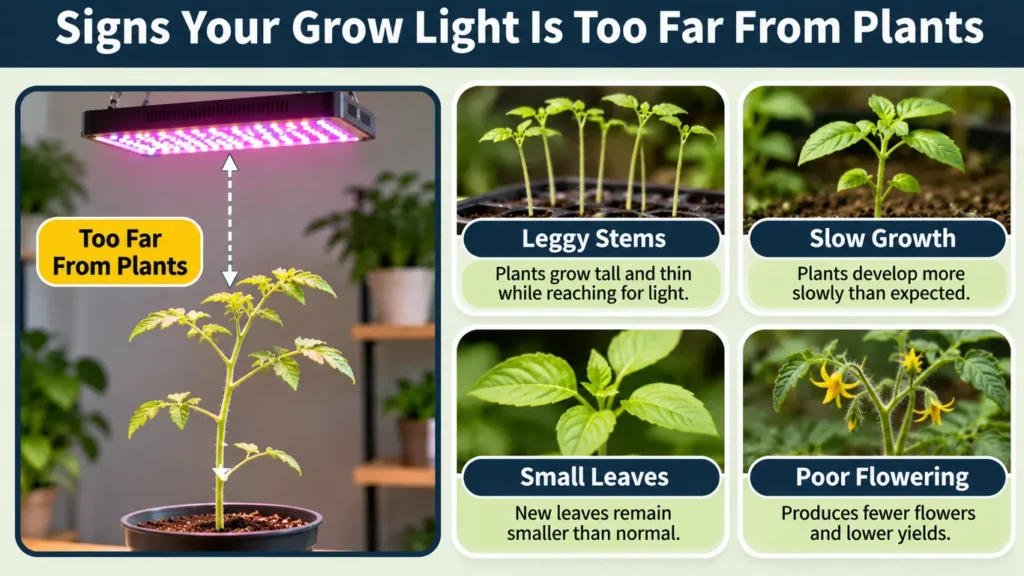
When grow lights are positioned too far away, plants may receive insufficient light for normal photosynthesis.
This commonly results in weak growth, particularly among seedlings and fast-growing vegetables. Identifying these problems early allows you to correct the light position before plants become severely stretched.
Common Signs of Insufficient Light
- Leggy stems: Plants develop unusually long, thin stems while reaching toward the light.
- Slow growth: Leaves and stems develop more slowly than expected.
- Small leaves: New foliage may remain smaller than normal.
- Weak stems: Seedlings may lean, bend, or struggle to remain upright.
- Poor flowering: Fruiting plants may produce fewer flowers or develop slowly.
Gradually lowering the fixture or increasing brightness can improve growth when insufficient light is the cause.
How to Adjust Grow Light Distance Correctly
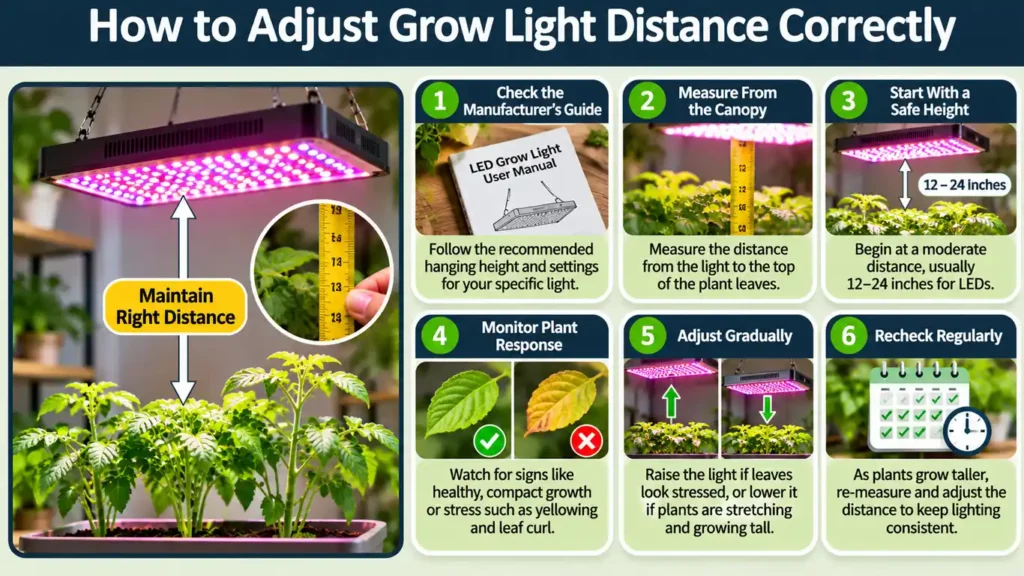
Proper positioning involves more than hanging a light at a fixed height. Plants grow continuously, and their lighting requirements change over time.
Regular adjustments help maintain consistent exposure while reducing the risk of excessive brightness or heat.
Steps for Proper Grow Light Placement
1. Check the manufacturer’s guidelines. Find the recommended hanging height for your particular fixture and crop.
2. Measure from the canopy. Measure the distance between the light and the tallest leaves rather than the soil surface.
3. Begin with a conservative height. Start at the recommended distance and avoid maximum brightness for sensitive seedlings.
4. Monitor plant responses. Check for stretching, yellowing, curling, or other signs of stress.
5. Adjust gradually. Raise, lower, or dim the fixture according to plant requirements.
6. Recheck regularly. As plants grow taller, maintain adequate clearance between the light and foliage.
Understanding PPFD and Light Intensity
PPFD measures the amount of photosynthetically active light reaching a surface every second. It is expressed in micromoles per square meter per second (µmol/m²/s).
A PAR meter can help determine whether plants receive adequate light at their current distance.
Daily Light Integral (DLI) is also important because it measures the total usable light plants receive throughout the day. Both intensity and lighting duration influence plant development.
Yard and Garden
Common Mistakes When Positioning Grow Lights
Even experienced indoor gardeners sometimes make mistakes when adjusting artificial lighting.
Avoiding these common problems can improve plant health and help create more consistent growing conditions.
- Using wattage alone: A fixture labeled 600W or 2000W may not consume that actual wattage. Check its true power draw and PPFD measurements.
- Placing every plant at the same height: Different species and growth stages require different intensities.
- Ignoring heat: HPS and other heat-producing fixtures need sufficient ventilation and clearance.
- Forgetting plant growth: The distance decreases naturally as plants become taller.
- Leaving lights on continuously: Most plants benefit from a regular dark period.
- Ignoring light coverage: A light positioned too close may illuminate only a small section of the growing area.
FAQs
1. How Far Should a 600W LED Grow Light Be From Plants?
A true 600W LED grow light may need approximately 24–36 inches of clearance as an initial setting, especially for sensitive plants. However, the ideal height depends on fixture efficiency, dimming capability, growth stage, and measured light intensity.
2. How Far Should T5 Grow Lights Be From Plants?
Fluorescent T5 grow lights can often be positioned approximately 2–6 inches above seedlings. Higher-output T5 fixtures may need additional clearance. Raise the fixture as plants grow and monitor leaf temperature to prevent heat-related damage.
3. Can Grow Lights Be Too Far Away From Plants?
Yes. When grow lights are too far away, plants may receive insufficient light. This often causes slow growth, weak stems, and leggy seedlings. Moving the fixture closer or increasing brightness can help correct the problem.
4. How Many Hours Should Grow Lights Stay On?
Most indoor seedlings benefit from approximately 14–16 hours of artificial light daily. Many foliage plants need around 12–16 hours, depending on their light requirements. Use an automatic timer to maintain consistent lighting and darkness.
5. Should I Move My Grow Light as Plants Grow?
Yes. As plants become taller, raise the grow light to maintain an appropriate distance from their upper leaves. Regular adjustments help prevent excessive light exposure while keeping illumination consistent throughout the growing period.