
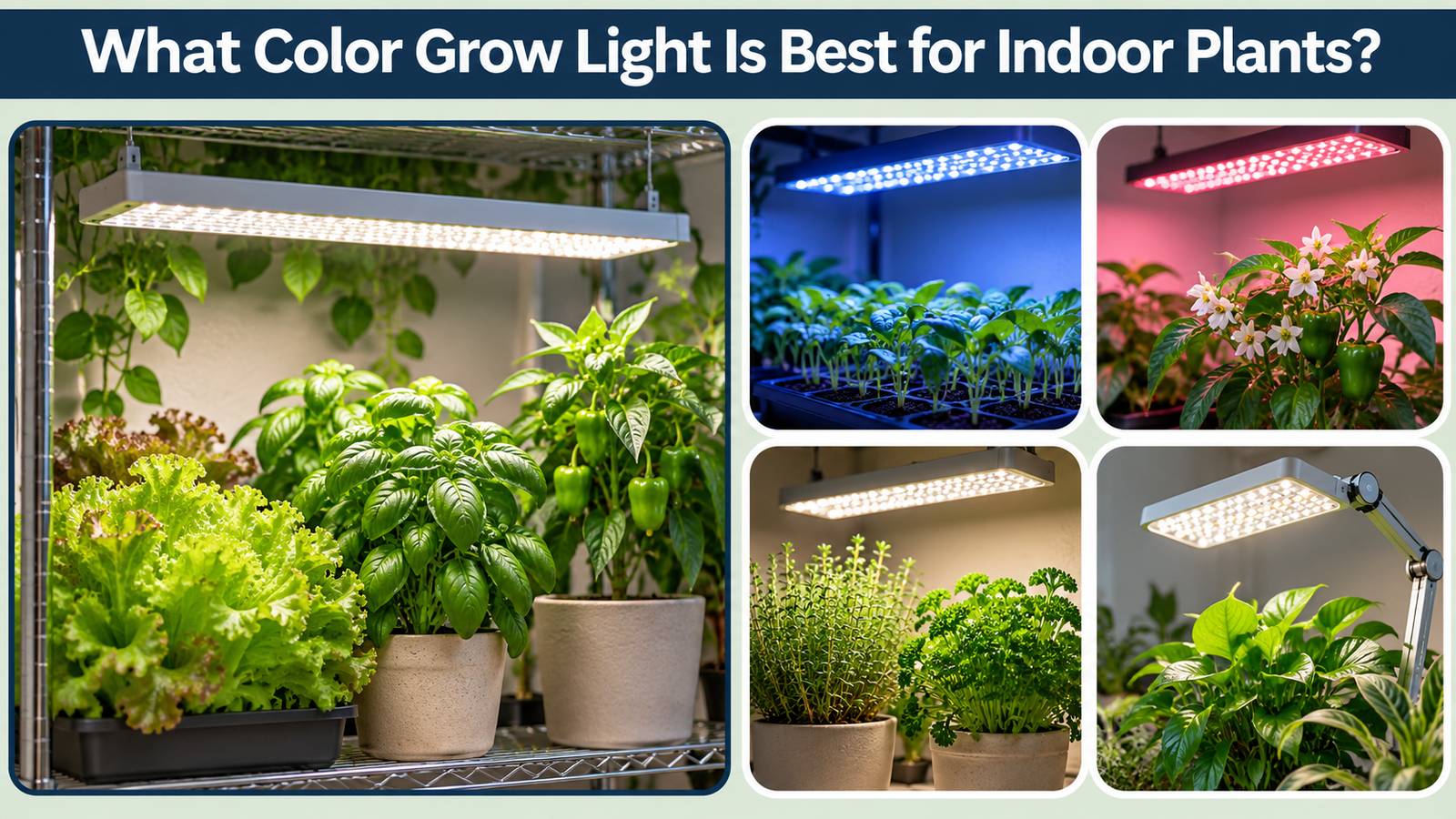
Choosing the right grow light color can make a significant difference in how well indoor plants grow. Sunlight contains many colors, but plants use certain wavelengths more efficiently for photosynthesis and development. Red, blue, white, and full-spectrum grow lights each affect plants differently, making it important to understand their benefits. Whether you’re growing houseplants, vegetables, seedlings, or flowering plants, the ideal light depends on your gardening goals. This guide explains what color grow light is best, how different colors affect plant growth, and which lighting options work best for indoor gardening.
What Color Grow Light Is Best for Plants?
Full-spectrum white LED grow lights are the best overall choice for most indoor plants. They provide a broad range of wavelengths that support photosynthesis, healthy leaves, root development, and flowering. Although plants primarily use red and blue light for photosynthesis, other wavelengths also contribute to plant growth and development.
Different light colors affect plants in different ways. Blue light helps regulate compact growth and leaf development, while red light efficiently drives photosynthesis and influences flowering responses. Full-spectrum grow lights combine several useful wavelengths, making them suitable for different growth stages.
Best Grow Light Colors at a Glance
| Grow Light Color | Main Benefits | Best For |
|---|---|---|
| Full-Spectrum White | Supports overall plant growth | Most indoor plants |
| Blue Light | Encourages compact growth and leaf development | Seedlings and leafy greens |
| Red Light | Supports photosynthesis and flowering responses | Flowering and fruiting plants |
| Red and Blue Combination | Provides two important photosynthetic wavelength ranges | Indoor vegetables and herbs |
| Warm White | Offers more red-rich visible light | Flowering plants |
| Cool White | Offers relatively more blue-rich visible light | Seedlings and foliage plants |
| Green Light | Penetrates deeper into dense plant canopies | Supplemental lighting |
For most home gardeners, a quality full-spectrum LED is the most practical option because it supports a wide variety of plants without requiring separate lights for each growth stage.
How Different Grow Light Colors Affect Plant Growth
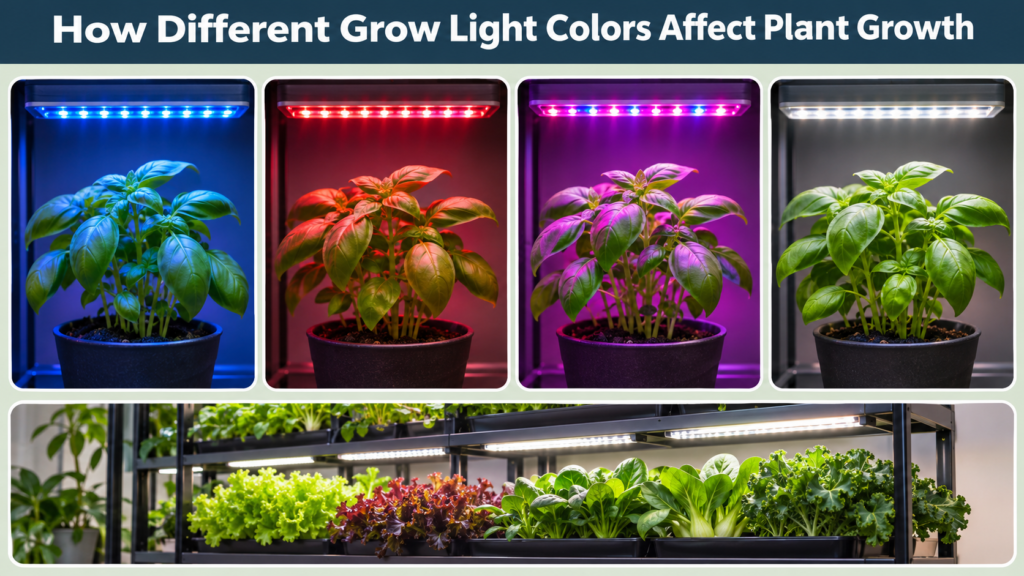
Plants respond differently to various wavelengths of light. While red and blue wavelengths are especially important for photosynthesis, green and other visible wavelengths also contribute to plant development. Understanding these differences helps indoor gardeners choose suitable lighting for vegetables, flowers, and houseplants.
1. Blue Grow Light
Blue light typically falls within the 400–500 nanometer wavelength range. It plays an important role in regulating plant growth, leaf development, stomatal opening, and responses to light direction.
Blue-rich lighting often encourages compact plants with shorter stems and well-developed leaves.
Benefits of blue grow lights:
- Supports healthy leaf development.
- Helps prevent excessively elongated stems.
- Encourages compact seedling growth.
- Supports normal plant responses to light.
- Works well as part of a balanced spectrum.
Blue light is especially useful during early vegetative development. However, using only blue light is generally less practical than providing a balanced spectrum.
2. Red Grow Light
Red light generally covers wavelengths between 600 and 700 nanometers. It is highly effective at supporting photosynthesis and contributes to plant growth, flowering responses, and stem development.
Many horticultural LED systems use red wavelengths around 660 nanometers because chlorophyll absorbs light efficiently in this region.
Benefits of red grow lights:
- Provides energy for photosynthesis.
- Supports plant growth and biomass production.
- Influences flowering responses in certain species.
- Complements blue light in horticultural systems.
Red light alone is not ideal for every plant. Without sufficient blue light, some plants may develop abnormal growth patterns or excessively elongated stems.
3. White Grow Light
White grow lights provide a mixture of visible wavelengths that appears white to human eyes. Many white LEDs produce blue light combined with phosphors that generate additional colors.
White light offers balanced illumination for growing plants while making it easier to inspect leaves, stems, and soil.
For everyday indoor gardening, white LED grow lights are particularly convenient because they create a natural-looking growing environment.
4. Green Grow Light
Green light occupies approximately 500–600 nanometers of the visible spectrum. Although green leaves reflect some green light, plants also absorb and use a significant portion of it for photosynthesis.
Green wavelengths can penetrate deeper into dense foliage than strongly absorbed red and blue wavelengths.
However, green-only grow lights are generally unsuitable as the primary lighting source for indoor vegetables or houseplants.
5. Purple Grow Light
Purple grow lights usually combine red and blue LEDs. Their distinctive pinkish-purple appearance comes from mixing these two colors.
These lights can support healthy plant growth when their intensity and spectrum are appropriate.
However, purple lighting makes it more difficult to identify leaf discoloration, pests, or nutrient deficiencies. Modern full-spectrum white LEDs are often more convenient for home gardening.
What Color Grow Light Is Best for Different Growth Stages?
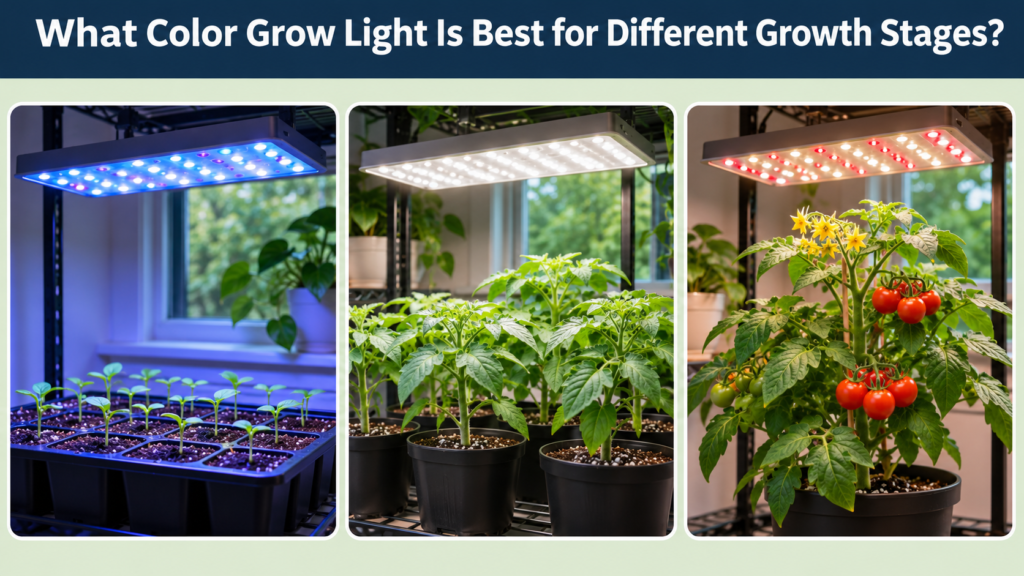
A plant’s lighting requirements can change as it develops from a seedling into a mature plant. Blue-rich light is commonly useful for compact vegetative growth, while red-rich light can support flowering and fruit production. However, most plants perform well under balanced full-spectrum lighting throughout their life cycle.
Best Grow Light Color for Seedlings
Blue-rich white light or full-spectrum LED lighting is an excellent choice for seedlings.
Blue wavelengths help regulate stem elongation and encourage compact growth. Seedlings also need adequate light intensity to develop healthy leaves and strong stems.
Place grow lights at the manufacturer’s recommended distance above the seedlings. Adjust their height as plants grow to maintain appropriate light intensity.
Best Grow Light Color for Vegetative Growth
During vegetative growth, plants concentrate on producing leaves, stems, and roots.
Full-spectrum white lighting with an adequate blue component is suitable for this stage. It supports photosynthesis while helping plants maintain healthy growth patterns.
Leafy vegetables such as lettuce, spinach, kale, and Swiss chard can grow successfully under balanced white LED lighting.
Best Grow Light Color for Flowering
Red-rich full-spectrum light is commonly used for flowering plants.
Red wavelengths influence plant development and can contribute to flowering responses. However, flowering also depends on the plant species, photoperiod, temperature, maturity, and overall growing conditions.
Some plants require specific periods of uninterrupted darkness to initiate flowering.
Best Grow Light Color for Fruiting
Tomatoes, peppers, cucumbers, and strawberries benefit from high-quality full-spectrum grow lights that provide sufficient intensity.
Red wavelengths support photosynthesis, but successful fruit production requires more than a particular light color.
Fruiting plants generally need greater total light exposure than many leafy vegetables. Temperature, nutrition, watering, and pollination also influence fruit production.
What Color Grow Light Is Best for Indoor Vegetables?
Full-spectrum white LED grow lights are an excellent choice for most indoor vegetables because they provide balanced wavelengths for photosynthesis and development. However, different vegetables require different light intensities and daily light exposure. Leafy greens usually need less light than fruiting vegetables such as tomatoes and peppers.
Best Grow Light Color for Lettuce and Spinach
Lettuce and spinach grow well under full-spectrum white LEDs with adequate blue light.
Blue wavelengths help support healthy leaf development and compact growth. These vegetables generally tolerate lower light levels than tomatoes and peppers.
For many home setups, approximately 12–16 hours of suitable artificial light daily provides a useful starting point.
Best Grow Light Color for Tomatoes
Tomatoes grow best under sufficiently powerful full-spectrum LEDs that include useful red and blue wavelengths.
Because tomatoes are high-light crops, providing enough total light is usually more important than selecting a red-only or blue-only bulb.
Indoor tomato plants may benefit from approximately 14–16 hours of artificial lighting daily, depending on the intensity.
Best Grow Light Color for Peppers
Peppers benefit from balanced full-spectrum light, particularly when producing flowers and fruit.
Warm white LEDs or horticultural full-spectrum LEDs containing additional red wavelengths can work well.
However, light intensity and daily exposure strongly influence plant productivity. A weak red light will not necessarily outperform a powerful, balanced white light.
Best Grow Light Color for Herbs
Most culinary herbs grow successfully under full-spectrum white LEDs.
Basil, parsley, cilantro, and mint generally benefit from bright lighting. Their exact requirements differ, with basil typically needing more light than mint.
For a mixed indoor herb garden, full-spectrum lighting offers a flexible solution.
Warm White vs. Cool White Grow Lights: Which Is Better?
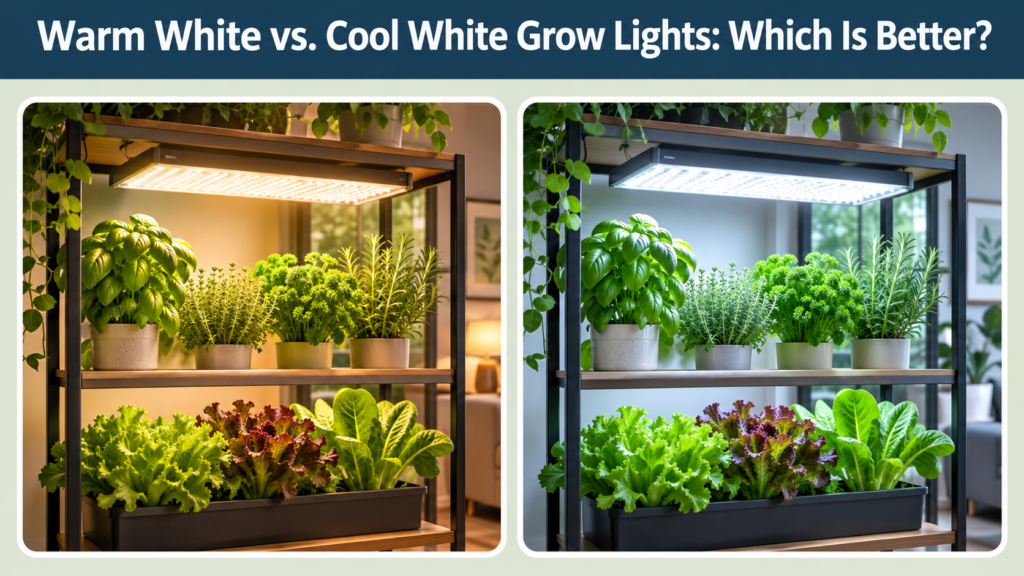
Warm white and cool white grow lights differ mainly in their visible spectral distribution and color appearance. Warm white LEDs typically contain a relatively greater proportion of longer wavelengths, while cool white LEDs have a stronger blue component.
Both can support plant growth when they provide adequate photosynthetically active radiation.
| Feature | Warm White Grow Light | Cool White Grow Light |
|---|---|---|
| Typical Appearance | Yellowish-white | Bluish-white |
| Common Color Temperature | 2700–3500K | 5000–6500K |
| Relative Spectrum | More red-rich | More blue-rich |
| Common Applications | Flowering and general growth | Seedlings and leafy plants |
| Suitable for Vegetables | Yes | Yes |
| Best Overall Use | Supplemental or general lighting | Vegetative and general lighting |
Is 3000K or 6500K Better for Plants?
Both 3000K and 6500K LEDs can grow plants successfully.
A 3000K bulb generally produces a warmer, relatively red-rich spectrum, while a 6500K bulb produces cooler, relatively blue-rich illumination.
For a mixed indoor garden, a balanced full-spectrum grow light is often preferable to choosing a bulb based solely on color temperature.
Color temperature does not indicate how much usable light reaches a plant.
Full-Spectrum vs. Red and Blue Grow Lights
Full-spectrum and red-blue grow lights can both support photosynthesis, but they differ in appearance, spectral coverage, and everyday practicality.
Red-blue lights concentrate their output in selected wavelength ranges. Full-spectrum white lights distribute more output across the visible spectrum.
| Feature | Full-Spectrum LED | Red and Blue LED |
|---|---|---|
| Light Appearance | Natural white | Pink or purple |
| Plant Growth | Supports all major growth stages | Can support all major stages |
| Leaf Inspection | Easy | More difficult |
| Indoor Appearance | Natural-looking | Unusual-colored lighting |
| Best For | Home gardens and mixed plants | Specialized growing setups |
| Overall Convenience | Excellent | Moderate |
Which Grow Light Is Better for Beginners?
Full-spectrum white LED grow lights are generally better for beginners.
They are convenient for growing different plants together, provide natural-looking illumination, and allow gardeners to recognize common problems more easily.
Red-blue fixtures can also be effective, but their performance depends on the actual spectrum, intensity, efficiency, and coverage.
How to Choose the Right Grow Light Color for Plants
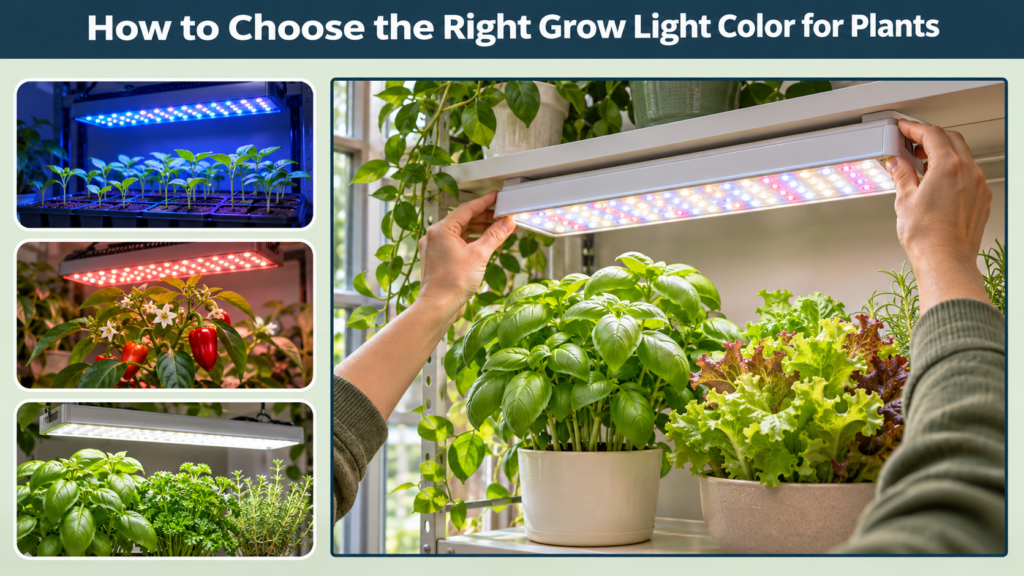
Choosing an effective grow light involves more than selecting a color. Light intensity, coverage area, mounting height, and daily exposure are often more important for successful indoor gardening.
1. Look for Full-Spectrum Lighting
Choose an LED grow light designed to support photosynthesis across different growth stages.
Full-spectrum white lighting is a practical starting point for houseplants, herbs, seedlings, and indoor vegetables.
2. Check the PPFD Rating
PPFD stands for photosynthetic photon flux density. It measures how many photosynthetically active photons reach a square meter of growing area each second.
Different crops require different PPFD levels.
Approximate starting ranges include:
- Seedlings: 100–300 µmol/m²/s.
- Leafy greens: 150–400 µmol/m²/s.
- Fruiting vegetables: 300–700 µmol/m²/s or higher, depending on conditions.
These are general guidelines, not fixed requirements for every species.
3. Consider Daily Light Duration
Light duration affects the total amount of energy plants receive.
Many indoor vegetables benefit from 12–16 hours of artificial lighting daily, depending on light intensity and species.
Plants also need appropriate dark periods, and some flowering species respond strongly to day length.
4. Match the Light to Your Growing Space
Choose a fixture that adequately covers your containers or growing shelves.
A small bulb may work for a few herbs, while a larger vegetable garden may require multiple LED panels.
Follow the manufacturer’s hanging-height recommendations and adjust the fixture as plants grow.
Frequently Asked Questions
What Color LED Light Is Best for Plant Growth?
Full-spectrum white LED light is generally the best choice for overall plant growth. It provides a broad range of useful wavelengths, including red and blue. Most houseplants, herbs, and vegetables can grow successfully under full-spectrum lighting when they receive appropriate light intensity and daily exposure.
Is Red or Blue Light Better for Plants?
Neither red nor blue light is universally better. Red light efficiently supports photosynthesis and influences flowering responses, while blue light regulates leaf development and compact growth. A combination of wavelengths usually produces more balanced development than relying on either color alone.
Is Purple or White Grow Light Better?
White full-spectrum grow lights are generally more convenient for indoor home gardening. They provide balanced illumination and make it easier to inspect plants. Purple grow lights can also be effective, especially when designed with suitable red and blue wavelengths. Overall performance depends on intensity and spectrum.
What Color Grow Light Is Best for Indoor Plants in Winter?
Full-spectrum white LED grow lights are ideal for most indoor plants during winter. They compensate for reduced natural daylight and help maintain healthy growth. Adjust lighting duration and intensity according to the plant species, since some houseplants naturally require less light during cooler months.
Can Regular White LED Lights Grow Plants?
Yes, regular white LED lights can support plant growth if they provide sufficient photosynthetically active light. However, ordinary household bulbs may lack the intensity or coverage required for demanding vegetables. Purpose-built LED grow lights are often more practical for larger indoor gardens and fruiting crops.